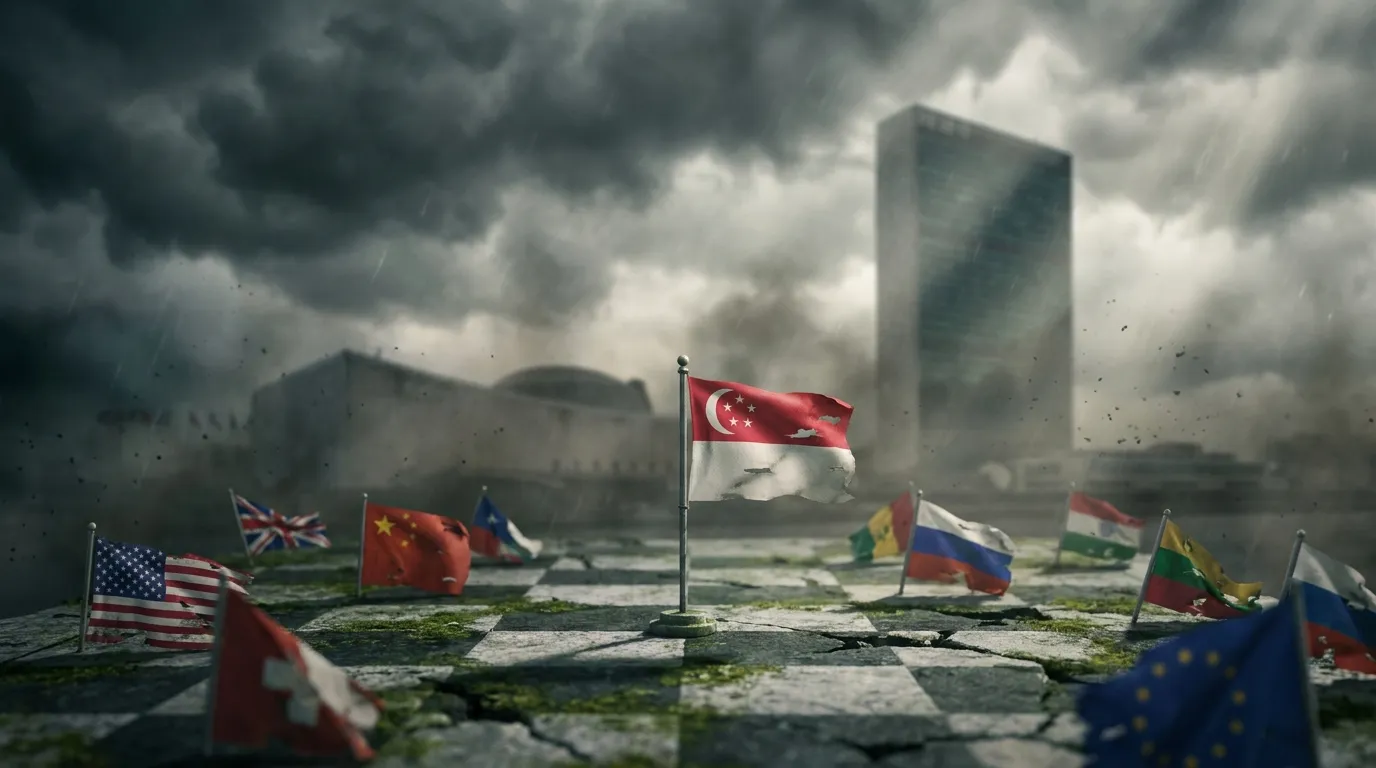
Who Still Plays by the Rules? Why Singapore Won't Give Up on Global Order
As Russia, the US, and Iran tear up the rulebook, Singapore keeps defending the rules-based order it helped write. Why one small state still plays fair.
Assassinated. This was the fate of Ayatollah Ali Khamenei, the man who had ruled Iran for more than three decades. For much of the world his death was a cause of celebration. Yet, it raised an uneasy question: who still plays by the rules? The killing of a head of state and the closure of the Strait of Hormuz are only the most violent chapters of the war on Iran. Russia’s invasion of Ukraine, United States abduction of Venezuela president Nicolás Maduro and China’s militarisation of the South China Sea are manifestations of a fraying global order. For now, the unravelling is only partial and rules are still upheld across ordinary life. However, if the leaders of the world’s superpowers keep blatantly disregarding the order their predecessors built and maintained, we may end up living out the logic of Dr Strangelove (1964) – a world where the powerful posture in their war rooms as the machinery of catastrophe grinds on, indifferent to the millions caught beneath it.
What is world order and who built it?
The postwar rules-based order is a covenant of binding codes, drafted jointly by much of the world. Instruments such as the United Nations Charter, General Agreement on Trade and Tariffs (GATT) and the United Nations Convention on the Law of the Sea (UNCLOS) are established to preserve global stability. Its principal architects were The United States of America, United Kingdom and the Soviet Union.
Challengers vs The Architect
Unfortunately, codifying rules across domains as vast as commerce and war did not deter nations from breaching them. The first breaches came from the challengers. Russia’s unlawful invasion of Ukraine in 2022 violated Article 2(4) of the UN Charter, which requires that ‘All Members shall refrain in their international relations from the threat or use of force against the territorial integrity or political independence of any state, or in any other manner inconsistent with the Purposes of the United Nations.’ Iran’s closure and militarisation of the Strait of Hormuz, in turn, violates UNCLOS and the freedom of navigation it guarantees.
Worse still, the very architects that established international law are abandoning it. In 2026, the United States, acting alongside Israel, bombarded Iran with multiple missile strikes, resulting in the death of hundreds of civilians along with the country’s supreme leader. America declared war on Iran. President Donald Trump justified that the purpose of the attacks was to neutralise Iran’s nuclear and ballistic missile capabilities. But the mere prospect of a future threat confers no right of pre-emptive force. The UN Charter prohibits unprovoked attacks against other countries. The illicit nature of the war not only violated international law, but also contravened domestic laws.
Tellingly, the strikes were never authorised by Congress. This begs the question: What weight do domestic laws have on an administration? Can democratic processes be ignored without repercussions?
This was not the first time the administration has disregarded international and domestic laws. When Trump was re-elected in 2025, he slapped all countries with unjustifiable, sky-high tariffs. At one point, the US imposed a massive 145 percent total tariff rate on many Chinese imports. Even friends were not spared. Singapore, a country with which the US actually runs a trade surplus, was still hit with a 10% tariff. These measures struck at two distinct pillars of the trade order at once. By charging China 145 percent while charging others a fraction of that, Washington offended the Most-Favoured-Nation principle of Article I of the GATT, which requires that any advantage or penalty applied to one member be extended equally to all. And by pushing rates far above the ceilings it had formally negotiated and bound itself to, it breached Article II, which holds each member to the tariff schedules it agreed to honour. Together, they show a country not bending the rules of the system it built, but walking out of it completely.
Hypocrisy runs through every one of these violations. The United States is walking away from the very system it created — without any repercussions.
Why no one stops it – the toothless referees
Some may find comfort in the presence of international governing bodies like the United Nations, imagining them as impartial referees. However, like a guard dog that doesn’t bite, its effectiveness is limited. The UN Security Council’s paralysis and ineffectiveness is evident from its failure to stop the genocide in Gaza, stop the US and Israel in the war that they have imposed on Iran, and Russia’s war on Ukraine. Unbeknownst to many, its inability to exercise its power stems from its structure. Power within the UN system is unequally distributed. And it reflects the international architecture that was built after the second world war and who its victors were. The permanent five members of the Security Council, each victors of the Second World War, holds decisive authority over questions of peace and security. Each wields veto capable of shutting down any call for peace outright. Time and time again the UN has been reduced to a bystander in wars and crises. Consequently, faith in multilateralism is draining away, with trust in institutions like the UN Security Council reaching an all-time low.
Singapore: The Exposed Small State
In the midst of fraying global politics, one small nation refuses to let others bend its principle. Singapore, home to over 6 million people, holds true to its convictions. Often caricatured as coldly pragmatic, it has nonetheless declined to trade away its moral purpose to appease larger powers. Though small in size, it is a force to be reckoned with on the world stage. Tommy Koh, a Singaporean diplomat, was the principal architect of UNCLOS and chaired the Third United Nations Conference on the Law of the Sea. Not only has Singapore helped write the rules, but it also defends them on principle. In 2022, it made a move that seemed bold for a vulnerable small nation. It placed sanctions on Russia. In fact, it is the only country in Southeast Asia to do so. When questioned, it stood firm, strictly objecting to the baseless invasion of a sovereign country.
Singapore has likewise refused to negotiate or pay tolls with Iran for safe passage through the Strait of Hormuz. Leaders, including Foreign Affairs Minister Vivian Balakrishnan, insist that unimpeded transit is a non-negotiable right under UNCLOS. Because Singapore heavily relies on that convention for its own sovereignty and the protection of the Strait of Malacca, it cannot afford to compromise on this maritime principle. To bargain over passage even once would be to concede that the right itself is negotiable.
Still, Singapore’s resolve runs up against the timidity of small and middle powers. Those with the most to lose are often the quickest to submit, retreating into the Law of the Jungle for fear of offending a superpower. The result is a studied blindness to flagrant violations. Singapore knows what blindness costs. The moment rules are treated as optional, its sovereignty becomes a courtesy that larger powers may withdraw at will. That is the hidden threat beneath the headlines about Iran, Ukraine and tariffs.
Yet someone must keep the flame alive. If every small state retreats into the Law of the Jungle, the architecture collapses by consensus, and nothing will be left to return to when the strongmen finally tire of their war rooms. Singapore’s wager is that principle can outlast power — that a rule honoured by the few may still shame the many, and one day bind them again.
So we return to the question that haunts this fraying world: what does it mean to be the last one still playing by the rules in a game the referees have left? Perhaps it means refusing to concede that the game is over. Perhaps the rules survive not because they are enforced, but because someone, somewhere, still insists they matter.